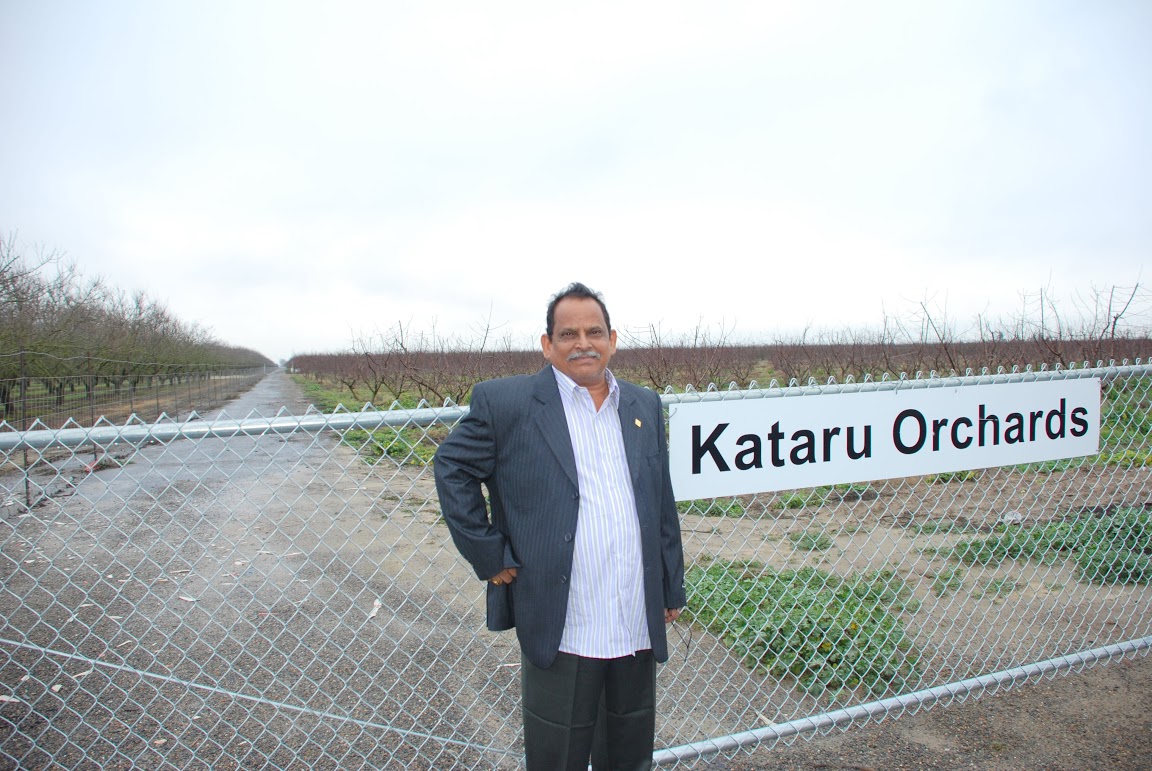
Farming is not easy, not pretty, not wildly profitable. And I had no prior experience; then, why did I even get into it? I believe I felt a connection. Plus the challenge excited me - To be a successful farmer nowadays, one has to be equal parts entrepreneur and agronomist. As I dug into it, I also found farming to be fulfilling. That's how I branched into agriculture, as the Sanskrit aphorism "Vriksho Rakshati Rakshitaha" (Trees, when protected, protect you) took on a new meaning for me.
Tuesday, January 15, 2008
Sunday, August 12, 2007
More harvest! Del Monte discards too many peaches?
These are all "yellow cling peaches." Peaches you usually find on grocery aisles are "free stone" peaches where the flesh of the fruit doesn't stick to the stone. But, peaches grown in our ranch are all cling-stone peaches. These are supposed to be more flavorful (smell beautiful), less juicy, more firm and just as sweet if not sweeter. In summary, yellow cling peaches are way better tasting than freestone peaches. So, look for them in whole foods or specialty produce stores.
We supply all of our peaches to Del Monte, which cans them in a nearby factory.
It seems as though they discard a lot of peaches, but in fact it is a minuscule percentage of picked fruit and are considered of "inferior quality" by Del Monte. However, I just don't understand why the pickers are not trained to leave them on the trees.
All these picked peaches are going to their Modesto Canning facility where they are going to remove the skin, pit them, slice them up and store them up in 10 lb cans. I am told, these cans will be utilized all throughout the coming year for mixing in yogurts, making small fruit cups, etc.
Thursday, August 9, 2007
Almond harvest and "Shaker Blight"
Peach harvest involves farm workers going around in the orchard from tree to tree and picking fruit by hand. Nothing new..
But, almonds are harvested in an entirely new (to me!) way. By shaking the trees. Yes.
- A shaker head attaches to the tree trunk to shake the nuts from the tree.
- The nuts fall to the ground, are left to dry.
- Later, they are blown from around the tree and swept into windrows.
- A pickup machine gathers the nuts from the windrow and loads them into a truck.
Personally, it pains to see the trees being shaked. It cannot be a pleasant experience for them, right?
So, I did some research and talked to farming experts like Prof Roger Duncan on what kind of "side effects" shaking has. It turns out, "Shaker Blight" has been a major problem for almonds, although this has been remedied by recent improvements in the equipment design.
The major problem shakers cause is "barking" or slipped bark. That results from improper clamp pressure or movement of the rig after clamping. Modern shakers automatically lock the brakes when clamping pressure is achieved and this has reduced the incidence of slipped bark. A shaker is capable of shaking off a lot of twigs, but the duration and strength of the shake are variables that can be controlled to minimize this. Less energy is applied to young trees.
Infrequently a limb will break off, but these are usually limbs that were cracked or otherwise damaged and destined to break off anyway.
The biggest variable affecting the amount of damage is the operator.
Experience and desire to do a good job are important. Most of our shaker business goes to Mr. Randy Bennett. He owns two machines that he and his son and one employee operate. We like him.
Friday, July 20, 2007
Almonds splitting! Dry weather helps!!
In case you were wondering about that tall white structure, it is our bountiful ground water well. We don't really use it because we are in good water district (Turlock Irrigation District), but it could come in handy if California faces a long, drawn-out drought. Always good to have multiple water sources.
You hardly see many weeds on the ground. That's because Carpenter ranch is micro-sprinkler irrigated.
Saturday, July 7, 2007
It's not exclusive to Ants and Acacia trees..
You might have heard it. Ants and Acacia trees have a mutually beneficial agreement. Acacia tree provides its sugar rich sap and shelter to ants. Ants, in turn, protect acacia tree from grasshoppers and weeds.
In fact, every plant and tree on the planet forms symbiotic relationship with soil microbes for its survival.
Plants grow by trading things they produce from photosynthesis (plant sugars) for things excreted by the soil microbes (such as nitrogen, phosphorus, etc.).
In the process of photosynthesis, light energy from the sun is converted to chemical energy held within the bonds of the molecules of sugars produced. Most of the nutrients for plant growth come from the soil microbes which trade these nutrients for the carbon-based sugars produced by the plant’s photosynthesis. The plant exudes these sugars from its roots and attracts the soil biota. This all takes place in a 2 millimeter area around the roots (called the rhizosphere).
This is perfect. Plants need the nutrients like nitrogen and the soil biota need the carbon-based sugars and the chemical energy.
In fact, every plant and tree on the planet forms symbiotic relationship with soil microbes for its survival.
Plants grow by trading things they produce from photosynthesis (plant sugars) for things excreted by the soil microbes (such as nitrogen, phosphorus, etc.).
In the process of photosynthesis, light energy from the sun is converted to chemical energy held within the bonds of the molecules of sugars produced. Most of the nutrients for plant growth come from the soil microbes which trade these nutrients for the carbon-based sugars produced by the plant’s photosynthesis. The plant exudes these sugars from its roots and attracts the soil biota. This all takes place in a 2 millimeter area around the roots (called the rhizosphere).
This is perfect. Plants need the nutrients like nitrogen and the soil biota need the carbon-based sugars and the chemical energy.
It is a trading economy that has been in place since the beginning of life on Earth.
Soil microbes include various kinds of bacteria, fungi and protozoa. The big microbes (like protozoa) eat the little ones (bacteria). This makes the nutrients in the bacteria’s body (most importantly, Nitrogen) available to plants through the feces of the bigger microbes.
All Carbon-based life forms generally have a ratio of Carbon to Nitrogen of around 25 to 1, but bacteria are very Nitrogen-rich and have a Carbon to Nitrogen ratio of around 5 to 1. So, a big microbe (maybe a protozoa) needs to eat 5 bacteria to get 25 atoms of Carbon, but if it does it will get 5 atoms of Nitrogen. This is 4 more than it needs, so the extra Nitrogen is excreted and becomes available to plant roots. Luckily, the plants have been clever enough to attract the microbes to the rhizospere by offering all those sugars, so it is easy to get the Nitrogen.
Soil microbes include various kinds of bacteria, fungi and protozoa. The big microbes (like protozoa) eat the little ones (bacteria). This makes the nutrients in the bacteria’s body (most importantly, Nitrogen) available to plants through the feces of the bigger microbes.
All Carbon-based life forms generally have a ratio of Carbon to Nitrogen of around 25 to 1, but bacteria are very Nitrogen-rich and have a Carbon to Nitrogen ratio of around 5 to 1. So, a big microbe (maybe a protozoa) needs to eat 5 bacteria to get 25 atoms of Carbon, but if it does it will get 5 atoms of Nitrogen. This is 4 more than it needs, so the extra Nitrogen is excreted and becomes available to plant roots. Luckily, the plants have been clever enough to attract the microbes to the rhizospere by offering all those sugars, so it is easy to get the Nitrogen.
Monday, July 2, 2007
Tuesday, June 26, 2007
Gophers, Squirrels and Rabbits? Oh, my!!
So, I was taking a course on orchard management. One important aspect of it was "vertebrate pest management."
Orchards provide food and shelter for small animals that can cause significant damage:
- Squirrels feed on fruit and on tree bark and shoots, which can stunt growth or even kill trees.
- Rabbits will chew on flexible irrigation lines and emitters.
- Gophers will dig holes through the soil surface, thereby channeling surface irrigation water to undesired areas.
- Food safety also becomes an issue if pest residues come into contact with the fruit.
Management programs for vertebrate pests involve 4 basic steps:
- Correctly identify the pest species using damage signs, burrows or habitat, tracks, feces, etc.
- Modify the habitat to make the area less favorable to the pest species.
- Implement appropriate control. Includes baiting, fencing, shooting or trapping. Use due consideration for the environment and non-target species.
- Establish a monitoring system so as to detect re-infestation.
Subscribe to:
Posts (Atom)